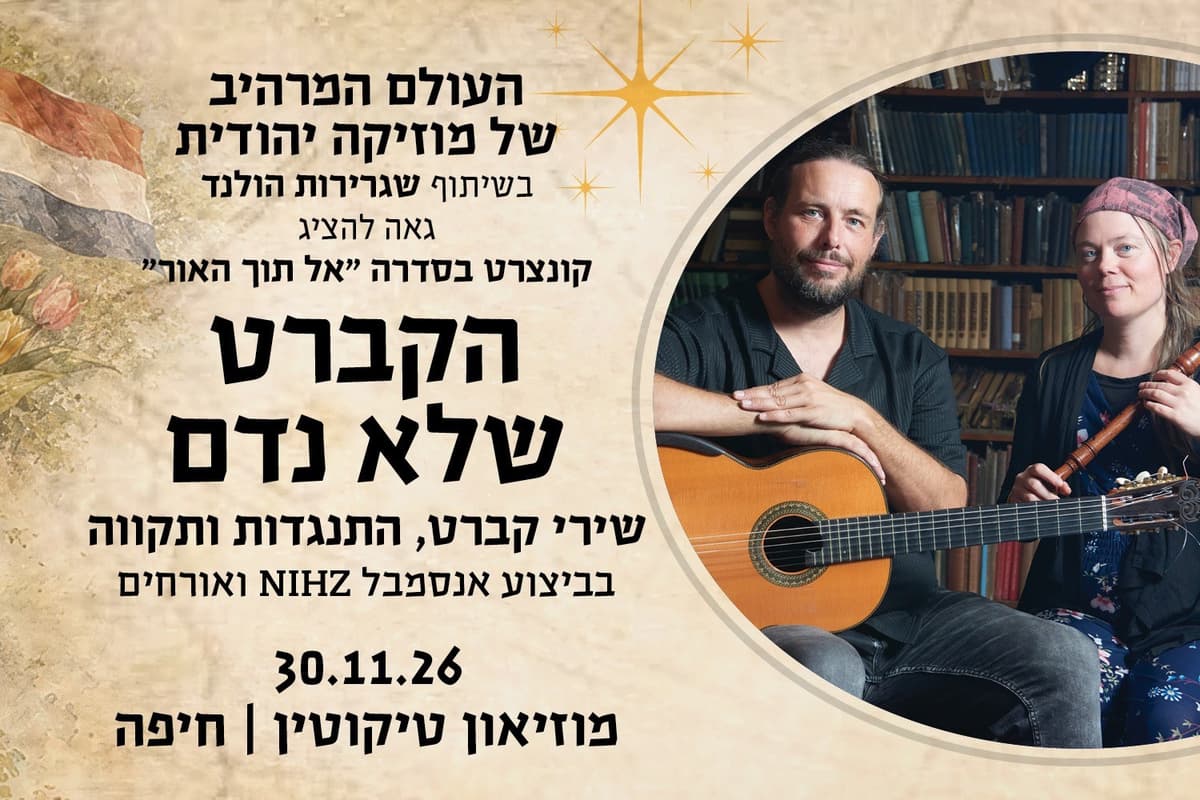
Sleepless Cabaret — Songs of Resistance and Hope
Weather · Haifa
A concert by the NIHZ ensemble and guest musicians in Hebrew and English. The program is dedicated to Jewish composers and performers from the Netherlands during the Holocaust.
Concert from the Towards the Light series in Hebrew and English
NIHZ Ensemble and guest musicians
Sena van Alst: vocals, recorders
Bobby Rothvelt: vocals, guitar
Orna Beine: percussion
Levi Rothvelt: vocals, percussion
Artyom Nizhnik: accordion
Gergo Pajmandi: clarinet, saxophone
Music by Jewish composers and artists from the Netherlands who continued composing and singing even during the Holocaust.
The Towards the Light project, in cooperation with the Embassy of the Netherlands, presents the NIHZ Ensemble and guest musicians in a program bringing together songs, cabaret numbers, and musical works created in Amsterdam, the Westerbork transit camp, Bergen-Belsen, and labor camps. Their creators were people whose lives were devastated by Nazi occupation and persecution, but whose drive to create proved stronger than their circumstances.
At the center of the evening is the story of Rob (Robert Emanuel) Heilbut (1909–1945), a Jewish composer, pianist, and cabaret artist from Amsterdam. In the 1930s, he was an active participant in the city’s vibrant cultural life and did not abandon his creative work even after the Nazi occupation. From 1942 to 1945, Heilbut wrote 36 songs—in Amsterdam’s Jewish quarter, at the Westerbork and Bergen-Belsen camps. They reflect the tragic reality of an era of persecution, yet through the pain and bitterness of loss emerge humor, irony, and indestructible human dignity.
Heilbut died just one day before the train deporting him to Germany was liberated by Soviet forces. For more than eighty years, his compositions were not performed on stage. Only through research by the NIHZ Ensemble, conducted over more than ten years, were they rediscovered and returned to audiences.
Alongside Heilbut’s works, the program will feature songs by Johnny & Jones, one of the Netherlands’ most popular musical duos of the 1930s. The artists performed throughout Europe, and their radio broadcasts brought them widespread recognition. After the Nazi occupation, they continued composing and performing music even while imprisoned at the Westerbork camp. Their songs, combining cabaret traditions, popular melodies, and subtle humor, offer a glimpse into the world of Jewish artists in the Netherlands during wartime. Their fate was tragic: neither survived the final months of the war.
The program also includes works set to poems by Fide Wolf, written in labor camps after the mass roundups in Rotterdam in November 1944. In his verse, Wolf captured his personal experiences and the harsh daily reality of forced labor. He survived the war, and his works were subsequently published in the Netherlands.
Another important figure in the program is Leo Fuld, one of the best-known Jewish singers in the Netherlands in the 20th century. During the Second World War, he was involved in the Dutch Resistance’s broadcasting activities, and in the postwar years he became one of the most recognizable performers of songs in Yiddish. A special place in his repertoire is held by Wo Ahin Soll Ich Geyn (“Where Shall I Go?”)—a song he received after the war from a man who had survived the Warsaw Ghetto and supplemented with a verse dedicated to the State of Israel. Leo Fuld’s story embodies the journey from catastrophe and destruction to the revival of Jewish culture.
Through the work of Heilbut, Johnny & Jones, Fide Wolf, Leo Fuld, and other artists, the program reveals the multifaceted world of Jewish musical life in the Netherlands during the Holocaust. Each of these artists spoke in their own musical language—whether cabaret, popular song, vocal lyricism, or traditional Jewish music. But they were united by one thing: the determination to continue creating even when their very lives were under threat.
This program is the result of extensive research conducted over more than ten years. NIHZ Ensemble members Bobby Rothvelt and Sena van Alst studied archives, museum collections, and private collections in the Netherlands, Germany, Israel, the United States, and Australia. They met with Holocaust survivors and their relatives, collected authentic testimonies of the era, and reconstructed works long considered lost.
The research into Rob Heilbut’s legacy culminated in the publication of a book in three languages and the release of a three-CD collection. Thanks to this work, an entire body of musical creativity that had remained unknown to the general public for decades has come back to life. Heilbut’s story also has a special connection to Israel: his brother’s descendants live here today.
For the NIHZ Ensemble, performing these works is more than a musical event. It is an opportunity to restore the voices of composers and artists whose lives and creative legacies nearly vanished from public memory. To let their music be heard again is to preserve the memory of people who, even in the darkest times, never stopped believing in the power of art.
Tickets are sold by FRIENDS רשת מועדוני תרבות ישראלית. Their customer support helps with orders and payment:
*9976WhatsAppservice@friends-hist.co.ilFRIENDS רשת מועדוני תרבות ישראלית help centre