OGO!
Tuesday 16/11/2027: Saint George Celebrations in Lod, the Dragon and the City’s Secrets
Tuesday (in 368 days)
November 16, 2027 at 10:00 AM
Summary
Free urban tour during the Saint George celebrations in Old Lod on November 16, 2027. Processions, stories, and history among churches and mosques.
Descriptiontranslated from Hebrew (original)
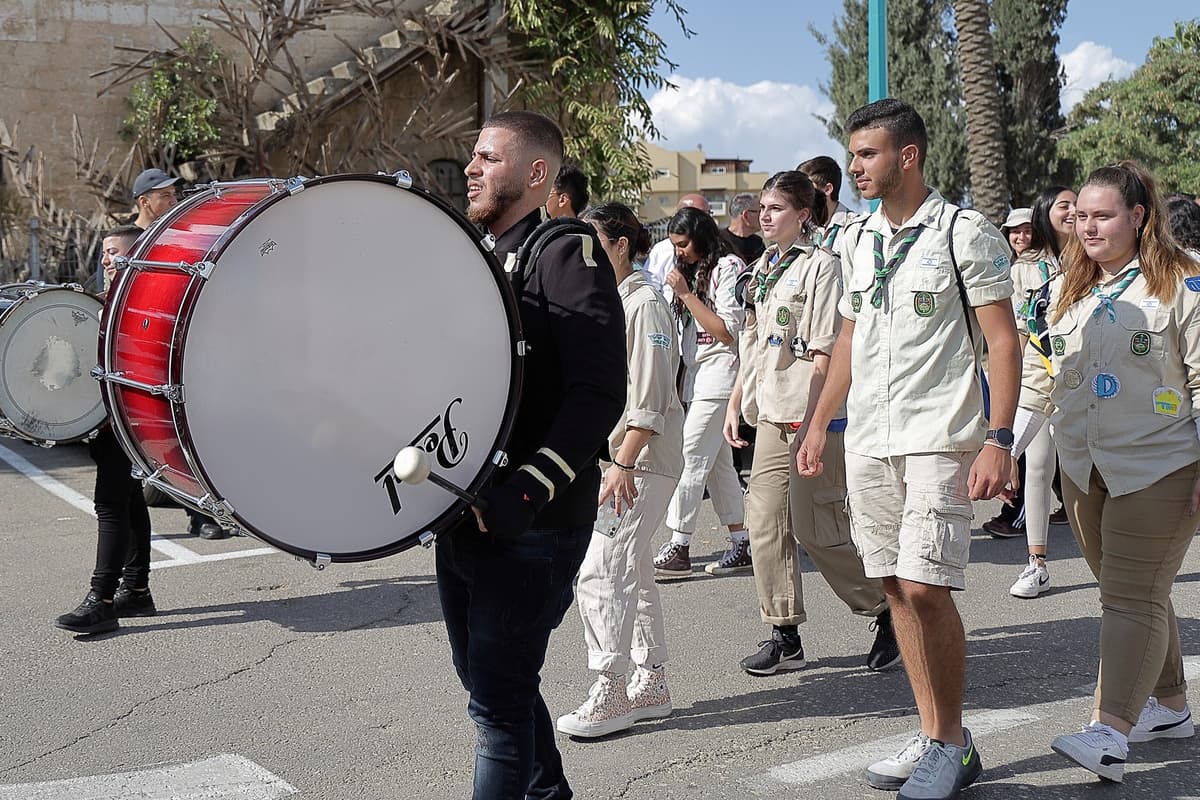
St. George’s Festival Procession in Lod, November 16, 2022. Photo: Lizzy Shanan, Pikiwiki Israel. Source · CC BY 2.5.
Free Tours / St. George’s Celebrations in Lod
Tours and Legends · Free Tour · Old Lod
Drums and Flags, Saint and Dragon: Lod Celebrates and Tells Its Story
There are days when history leaves the books and enters the streets. On the local feast day of St. George, we will set out for Old Lod, a city of churches and mosques, stone vaults, and stories that cross religious boundaries. We will seek to experience the atmosphere of the festival, observe the processions and customs as they take place, and discover how a soldier from Christian tradition became a knight fighting a dragon and a figure echoed in neighboring traditions.
Free of charge, guided by Tours and Legends
Self-arrival in Lod
Culture, legend, and history · Urban walk with explanatory stops
Led by the Tours and Legends team
For joining details, contact us on WhatsApp
Ahead of the feast day: The tour date and hours are as specified here. The order of stops, viewing of the procession, and entry into places of worship will be adapted to the local program, crowding, and the hosts’ instructions. The exact meeting point will be provided to participants in advance.
Experience the Festival Atmosphere: St. George’s Celebrations in Lod
Documentation from the celebrations of November 16, 2022, published by the Greek Orthodox Patriarchate of Jerusalem.
Watch the video on YouTube
What Awaits Us on the Tour?
The Celebrations and the Scouts’ Procession: Listening to the City
Scouts and bands participated in celebrations documented in Lod in previous years, with drums, flags, and a festive welcome for members of the clergy. We will try to join the events as respectful observers, listen to the rhythm, and understand who stands behind the costumes, symbols, and ceremony. This is a living community celebrating a religious festival, and we are its guests.
The November feast in Lod is connected to the dedication of the church and the tradition of transferring Georgius’s relics to the city. November 16 in the Gregorian calendar currently corresponds to November 3 in the Julian calendar used by the community to mark this occasion. It should not be confused with the saint’s commemoration day in spring.
Who Was George, and Where Is the Tomb Attributed to Him?
George is the English name of Georgius, also known as Jirjis and Mar Giris in Arab Christian traditions. Christian tradition tells of a soldier or officer in the Roman army who refused to renounce his faith and was executed during the persecutions. The details of his biography passed through saints’ stories, so we will distinguish between the tradition about his life and facts that can be documented with certainty.
According to Christian tradition, his burial place is in Lod. In the crypt beneath the Church of St. George in the Old City is a marble tomb attributed to him. It is a pilgrimage site for prayer and requests for blessings. The identification is an ancient religious tradition, not the result of modern forensic identification of remains.
If entry is possible, we will examine the church interior, the icons, and the connection between the upper hall and the sacred place beneath it. Entry to the crypt is not guaranteed on a busy day, and visiting it requires checking accessibility and stairs.
George and the Dragon: The Princess, Fate, and the Knight Who Would Not Pass By
According to one well-known version, a city lives in fear of a dragon. At first, animals are given to it to appease it, and later people are also selected by lot. When the king’s daughter’s turn arrives, her status does not save her. She stands before a fate that seems sealed, until a foreign knight passes by and refuses to accept the situation.
This is George. He faces the dragon, subdues it, and saves the princess. In one version, she herself leads the subdued monster into the city using her belt. The ending connects the victory with the acceptance of the Christian faith, and the deed becomes a symbol of the power of faith and triumph over evil. The story is especially well known through its versions in The Golden Legend, a medieval collection of saints’ stories.
The story contains more than a spectacular battle: Why does an entire city accept a cruel order as inevitable? Why does only a stranger dare to resist? And what changes when the princess moves from being a helpless victim to someone who leads the dragon? These are questions we will carry with us to the reliefs and icons.
This is a legend, not a historical report. The setting also varies between versions: some place the story in Silene in Libya, while others connect it to Lod. There is no need to invent a local “dragon lake” to enjoy the story. We will examine how the martyr and the knight merged in art and memory.
Interior of the church in Lod. Photo: Chris06, Wikimedia Commons, CC BY-SA 4.0.
George, al-Khidr, and Elijah: One Figure or a Bridge Between Traditions?
The encounter between religions does not take place only in theology books. In popular traditions of the Middle East, George is also associated with al-Khidr, “the Green One,” a figure of hidden knowledge, assistance, and protection. Scholarship has described connections between the veneration of George, al-Khidr traditions, and the memory of the prophet Elijah. Christians and Muslims may relate to the same site in different ways, and sometimes even share customs for seeking blessings.
However, it should not be inferred that George and Elijah were the same historical person, or that all Muslims regard George as a saint in the same way. Al-Khidr and Elias are also distinguished from one another in many Muslim traditions. We will discuss similarities, the borrowing of stories, and shared customs, alongside the differences. The municipal documentation of Lod’s celebrations also tells of Muslim visitors who came to the festival.
Add to calendar
Share this event:
Similar events
Loading similar events...