OGO!
Foraging Course at HaHorshot Park – Open to the General Public
November 20, 2026 – May 21, 2027
Ends in 178 days
Derekh Ben-Zvi 71, Tel Aviv-Jaffa
Weather · Tel Aviv
Key facts
- Sessions
- 8
- When
- on Fridays (at intervals of 3–4 weeks), from 9:00 to 12:00
- Level
- for the general public
Cost
900-1200 ₪
Summary
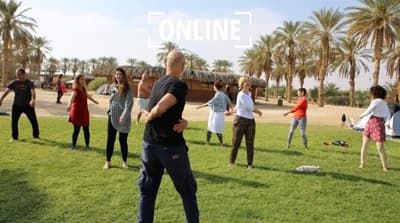
An 8-session foraging course at HaHorshot Park, led by Kobi Yehezqeli. Fridays, 09:00–12:00, from germination to seed dispersal.
Descriptiontranslated from Hebrew (original)
The foraging course of the School of Sustainability at HaHorshot Park, led by Kobi Yehezkel.
Discounted price for residents.
Payment can be spread over 12 installments.
8 sessions—Fridays, at intervals of 3–4 weeks, from 9:00 to 12:00.
In recent years, awareness and exposure to the world of foraging wild plants for various uses in the kitchen and medicine cabinet have been growing. The interest people are showing is not new, but rather a return to patterns that were customary throughout most of human prehistory and history.
People have always been interested in plants, studying and mapping them according to their properties, and have always found and created diverse ways to use them for their needs.
With the development of technology and industry in the modern world, we gradually found ourselves surrounded, on the one hand, by an endless abundance of readily available consumer products, and on the other hand, by urban spaces that, by their very nature, distanced us from wild plants.
The vast knowledge accumulated and learned through many years of intergenerational transmission was neglected and almost forgotten, except in cultures that, by their very nature, remained close to the land.
In the course, we will be exposed together to dozens of plant species and botanical trends, exploring and learning in sessions held at intervals that allow us to observe seasonal changes in the field—from germination in autumn to seed dispersal in early summer.
Each session will focus on a botanical trend and examples we find in the field.
First session—20 November—Germination
We will play a short introductory game, followed by an introductory talk about trends in botany and the uniqueness of the Land of Israel.
We will also discuss trends and principles in foraging.
Then we will go on a tour focusing on seedlings and the germination stage.
Seedlings are known to have especially good nutritional value, but alongside their many benefits, there are two main difficulties:
- The difficulty of collecting enough raw materials
- The difficulty arising from the danger of misidentification
We will learn how to overcome these difficulties, and at the end of the session we will receive a recipe for a Sicilian seedling salad with wild fennel and bitter orange.
Second session—18 December—Development of a Mature Plant
This session will focus mainly on the advanced germination stage, when seedlings become the green plants we all know.
We will observe the changes that have taken place in the field.
The tiny seedlings we saw in the previous session, which looked similar to one another and also resembled other plants, gradually become plants in their mature form.
We will learn that ḥubeza is actually a general name for many different plant species, and that there are also many other green plants suitable for eating.
We will learn to identify the plants and distinguish between them, and will receive a recipe for a traditional greens dish from Arab cuisine.
Third session—8 January—Winter Blossoming
In this session we will delve further into plant diversity and focus on the waves of red blossoms characteristic of this period.
We will learn about the role of flowers and the evolutionary idea underlying the variety of colors and shapes of flowers.
We will also learn about edible flowers and flowers useful in the medicine cabinet.
Fourth session—5 February—Toxicity
We will dedicate the fourth session to a significant topic in foraging skills: toxicity.
We will learn how plants protect themselves and get to know the most poisonous plant in the world.
We will also learn that even a poison, in a certain dosage, can be used as medicine, as well as methods for eliminating or reducing toxicity in plants.
Fifth session—26 February—Grains and Preparing for Spring
In this session we will identify the first signs of the changing season.
How do decreasing rainfall and the length of the day affect the environment?
We will learn about spring and the reasons for its name, rooted in botanical and agricultural characteristics.
Sixth session—19 March—Spring Blossoming
In this session we will return to learning about flowers, with an emphasis on spring flowers.
We will learn about their role and become acquainted with edible flowers.
In this session we will learn a recipe for preparing flower spring rolls.
Seventh session—16 April—Pickling and Herbal Preparations
We will dedicate the penultimate session of the course to seed dispersal, pickling, and herbal preparations.
In this session we will discuss the world of fermentation and pickling. We will become acquainted with plants and fruits in the park that are suitable for this purpose.
Eighth session—21 May—Closing Party
The group members will receive foraging and cooking assignments to prepare a complete foraged meal.
For updates in the School of Sustainability’s announcements-only group:
Link
Add to calendar
Share this event:
Similar events
Loading similar events...