OGO!
Three Legends. One Stage
Tuesday (in 98 days)
March 2, 2027 at 8:00 PM
Charles Bronfman Culture Hall
Huberman St 1, Tel Aviv-Yafo
Cost
399 ₪
Summary
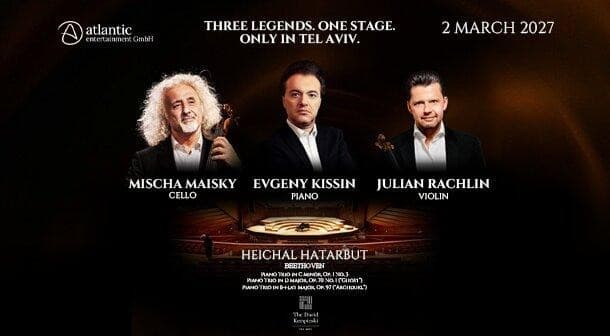
Concert by Yevgeny Kissin, Julian Rachlin, and Mischa Maisky featuring three piano trios by Beethoven. March 2, 2027, at the Culture Hall in Tel Aviv.
Descriptiontranslated from Hebrew (original)
Three Stars on One Stage: Evgeny Kissin, Julian Rachlin and Mischa Maisky Play Beethoven in Tel Aviv
Three names, each of whom can fill the world’s greatest concert halls on their own. Three musicians who have long been among the most prominent and renowned figures on the international classical music stage.
On March 2, 2027, pianist Evgeny Kissin, violinist Julian Rachlin and cellist Mischa Maisky will meet on the stage of the Culture Hall in Tel Aviv. The one-time concert by the three great artists will be devoted entirely to Ludwig van Beethoven.
The program features three piano trios, written during different periods of Beethoven’s life. This is a rare opportunity to follow, over the course of one evening, the composer’s development: from the young creator, who was only beginning to shape and express his unique musical voice, to the mature master, for whom the traditional boundaries of chamber music had become too narrow.
The evening will open with the Piano Trio No. 3 in C minor, Op. 1 No. 3—one of three works included in the opus Beethoven published first. The trios were published in 1795 and dedicated to Prince Karl Lichnowsky, a Viennese patron of the arts who played an important role in the young composer’s career.
Beethoven was still at the beginning of his path, but even in this early trio one can recognize the innovative spirit of the man who would go on to write the great symphonies. The classical chamber ensemble—piano, violin and cello—takes on dimensions unusual for its time. Instead of the customary three-movement structure, Beethoven builds a four-movement cycle, resembling a symphony in its structure and ending with a fast finale.
The next work on the program takes listeners to an entirely different period. The Piano Trio in D major, Op. 70 No. 1, known by the nickname “Ghost,” although Beethoven himself did not give it that name.
The nickname is associated primarily with the second movement, Largo assai ed espressivo: against a quiet tremolo background in the piano, a somber melody rises, and the music takes on a mysterious, almost otherworldly quality. As a result, the contrast with the surrounding movements becomes even more powerful. The first movement opens with a decisive unison by all three instruments and develops in opposition to the period’s conventional expectations: lyricism appears precisely where movement and activity are expected, while the more energetic character erupts in an unexpected place. The finale shakes off the darkness of the Largo, and movement and joy return to govern the music.
“Ghost” became one of Beethoven’s most famous piano trios—perhaps second in popularity only to the work that will conclude the concert.
The Piano Trio No. 7 in B-flat major, Op. 97—“Archduke”—is already the work of a mature Beethoven. Its name derives from its dedication to Archduke Rudolph of Austria, the composer’s student and patron.
“Archduke” is a work in which chamber music seems to break through its own boundaries. The three instruments are equal in status: this is no longer the pattern formerly accepted, in which the violin and cello accompany the piano, but rather a conversation among three independent and equal voices.
The scope of the four-movement cycle, the richness of its musical material and the complexity of the dialogue between the instruments bring the trio, in its dimensions and intensity, close to the symphonic world. It opens with a noble and restrained Allegro moderato, continues with a light and lively scherzo and the concentrated variations of the Andante cantabile, which flow without interruption into the concluding rondo. The work ends with music full of energy and joy.
The “Archduke Trio” is also connected to a dramatic episode in Beethoven’s own biography. At its first public performance, in the spring of 1814, the composer himself sat at the piano, alongside violinist Ignaz Schuppanzigh and cellist Joseph Linke. This was Beethoven’s last appearance as a pianist before an audience: his advancing hearing loss no longer allowed him to continue his concert career.
Beethoven turned the piano trio into a genuine conversation among three prominent voices. In the upcoming concert, this conversation will take on special meaning: its participants will be Mischa Maisky, Evgeny Kissin and Julian Rachlin—three musicians with very different artistic biographies, meeting for the first time on a chamber-music stage in Tel Aviv.
Evgeny Kissin, whom music critics have placed alongside the successors of Arthur Rubinstein, Sviatoslav Richter and Vladimir Horowitz, conquered the international stage while still a child. At the age of two he began playing by ear and improvising on the piano; at six he was admitted to the Gnessin School of Music; and at ten he was already performing with an orchestra.
His international breakthrough came in 1984, when 12-year-old Kissin performed Chopin’s two piano concertos in the Great Hall of the Moscow Conservatory.
He later performed with Herbert von Karajan and the Berlin Philharmonic, made his debuts at the BBC Proms and Carnegie Hall, and played with nearly all the world’s major orchestras under conductors including Daniel Barenboim, Carlo Maria Giulini, Mstislav Rostropovich, James Levine and Seiji Ozawa. Kissin is the recipient of two Grammy Awards and numerous international prizes, as well as honorary doctorates from several universities, including the Hebrew University of Jerusalem and Ben-Gurion University of the Negev.
Julian Rachlin also began his international career at a remarkably young age. At 14, he made his debut with the Vienna Philharmonic under Riccardo Muti and became the youngest soloist in the orchestra’s history.
Since then, he has performed as a violinist and violist with the world’s leading orchestras, including the Royal Concertgebouw Orchestra, the Chicago Symphony Orchestra, the New York Philharmonic, the Philadelphia and Cleveland Orchestras, the Bavarian Radio Symphony Orchestra and the Hong Kong Philharmonic. Rachlin has shared the stage with prominent conductors including Mariss Jansons, Lorin Maazel and Zubin Mehta.
Over nearly four decades, Rachlin has evolved from a virtuoso child prodigy into an artist whose activities extend far beyond a solo career. For more than 20 years, he has also appeared as a conductor with the Chicago Symphony Orchestra, the Vienna Symphony and the orchestra of Teatro alla Scala.
Today he serves as chief conductor of the Kristiansand Symphony Orchestra in Norway, artistic partner of the Rhineland-Palatinate State Philharmonic and music partner of the Yamagata Symphony Orchestra in Japan. From 2023 to 2026, he also served as music director of the Jerusalem Symphony Orchestra.
Mischa Maisky is the only cellist in the world to have studied with two of the great maestros of the 20th century—Mstislav Rostropovich and Gregor Piatigorsky. He was born in Latvia, educated in Russia and later immigrated to Israel, and has performed with the world’s leading orchestras and conductors—from Leonard Bernstein and Carlo Maria Giulini to Zubin Mehta, Vladimir Ashkenazy and Gustavo Dudamel.
Rostropovich described Maisky as one of the most outstanding talents of his generation, whose playing combines “poetry and refined delicacy with tremendous temperament and brilliant technique.”
For more than 30 years, Maisky was an exclusive artist of Deutsche Grammophon. His discography includes dozens of recordings with the Vienna Philharmonic, the Berlin Philharmonic, the Israel Philharmonic Orchestra, the London Symphony Orchestra and other leading ensembles. His longtime stage partners include Martha Argerich, Itzhak Perlman, Gidon Kremer, Maxim Vengerov and Lang Lang.
Maisky, Kissin and Rachlin have met many times on the world’s great stages and know one another well as chamber-music partners. The upcoming concert is therefore expected to be much more than a meeting between three exceptional soloists. It is a rare opportunity to hear three artists who know how to listen to one another, respond to one another and create music together, here and now.
The audience will be able to enjoy not only the virtuosity of the three performers, but also that unique feeling of a living musical dialogue. That is what brings us to the concert hall.
Mischa Maisky | Evgeny Kissin | Julian Rachlin
Ludwig van Beethoven
Piano Trio in C minor, Op. 1 No. 3
Piano Trio in D major, Op. 70 No. 1 (“Ghost”)
Piano Trio in B-flat major, Op. 97 (“Archduke”)
What the hall looks like
Photo credits
Avi1111 dr. avishai teicher · CC BY-SA 4.0
Add to calendar
Share this event:
Similar events
Loading similar events...