OGO!
The Great Mother: Maria Marfeld
December 3 – 26
Thursday (in 9 days)
Artists' House Tel Aviv
Elkharizi St 9, Tel Aviv-Yafo
Weather · Tel Aviv
Summary
An exhibition of multidisciplinary works by Maria Marfeld will open on December 3, 2026, at the Tel Aviv Artists’ House. The exhibition explores childhood memories, the sea, and mother-daughter relationships.
Descriptiontranslated from Hebrew (original)
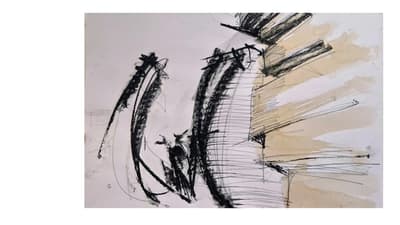
Artist Maria Marfeld dives into the depths of the Caspian Sea, into the murmur of waves whose movement carries with it memories of her childhood in Baku, Azerbaijan, during the communist 1960s. In a multidisciplinary body of work, Maria records her memories in ink and marker on paper and engraves images of the scars on her heart into wooden surfaces.
In the series The Red Journey, dense engravings of thin vertical and horizontal lines give rise to images of fish, nets, flying boats, bulls, and mummified archetypal figures, evoking mythological sea voyages. In the depths of the sea dwells the enormous beluga: the great mother, the nurturer, whose eggs were an everyday food in the artist’s family home. A beluga’s lifespan may reach approximately one hundred years, and therefore it represents an ancient memory carrying with it stories of the sea and journeys of the past, as well as the artist’s personal story and her complex relationship with her mother. From a Freudian psychodynamic perspective, the beluga dwells on the ocean floor of the unconscious. It is the most primordial, profound, and elusive image, and any attempt to raise it into conscious awareness requires a dive into the dark waters of childhood. In the work The Great Mother, Maria creates a perforated drawing of the beluga on paper. Light breaks through the tiny holes. And there she is, illuminated and radiating precious light, accompanied by a cello melody inspired by music from Azerbaijan and the sounds of the sea (cello and composition: Mayo Shaviro).
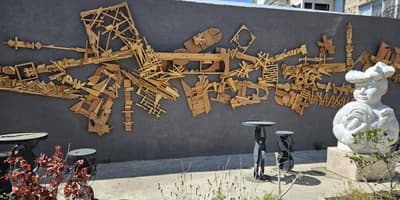
In other works, Maria brings up additional memories on her fishing line. The goldfish appearing in the triptych Three Wishes, created using repoussé on a brass surface, reveal themselves in all their beauty, densely clustered and in motion, as though they have just been caught in a fishing net. A kind of mass of gold representing hope for the fulfillment of heartfelt wishes. By contrast, the vertical wooden skewers echo the rhythm of oil-rig towers, restrictive and obstructive. Maria’s wish to the goldfish is a single one: to understand her relationship with her mother, the absence and the presence, and the question of love. Yet the wish is not granted; her memories are blurred. Thus, in a series of white works on paper titled Disappearance, the drawing of the oil rigs gradually fades. It begins as a clear pencil drawing on paper and ends in a work in which the image grows indistinct, like an amorphous stain—a visual expression of a vanished memory. The structures of Baku’s oil rigs rising upward, from whose chimneys the stench of black gold mingled with the salty scent of the sea, the touch of soft sand mixed with tar that stuck to her small feet—all these, the distant and recent past, the ugliness and the beauty, remained in Maria’s consciousness as memories that would not let go, moving between tangible presence and fiction, or like an illusion in the body of a fish that slips between the fingers and refuses to be held.
This exhibition joins Maria’s ongoing engagement with journeys, migration, the feeling of uprootedness, and mother-daughter relationships. A personal dictionary of concepts and forms drawing inspiration from memories, ancient cultures, folk tales, and fantasy. An inner mosaic woven into consciousness, in which sights, smells, and experiences merge into a single entity.
Nurit Tal-Tana, Curator
Language editing: Dr. Amit Kama
Add to calendar
Share this event:
Similar events
Loading similar events...